
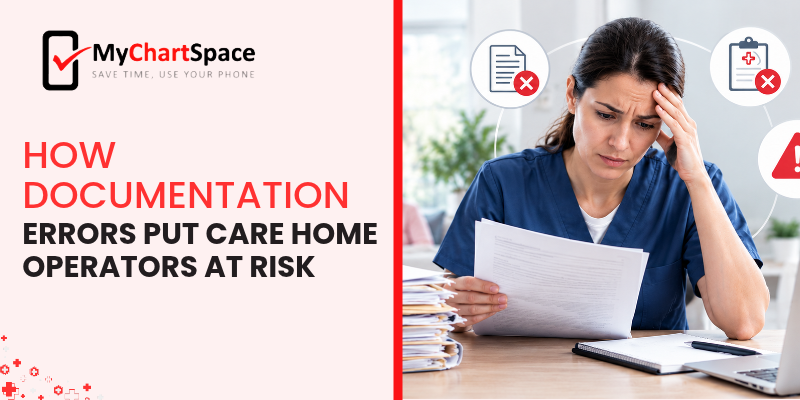
Small errors in care home records could become a big problem. At first glance, an unsigned signature, an unreadable comment, or a missed dosage entry might seem trivial.
But all of these errors make it harder to prove that the proper level of care was given to residents. Such mistakes will attract fines and a bad reputation for the care home during inspections.
In the case of medication errors, the residents’ health will be compromised and there will be an opportunity for legal claims against the home’s owner. The use of paper charts increases the risk of error during the working shift.
MyChartSpace is the best app to track medication for caregivers and can be helpful here, as caregivers could check medications off with one click, dictate their notes, and keep activity charts neat.
Table of Contents:
- What are the most common documentation errors in care homes?
- Why do documentation mistakes happen so often on busy shifts?
- How can a missed or unclear entry affect a resident’s safety?
What are the most common documentation errors in care homes?
Common mistakes in care home records commonly contain errors such as the absence of signatures, missing, repeated or absent dosage details, illegible handwriting, late entries and incomplete progress notes. Such gaps in documentation cause inconsistencies and problems for inspectors. MyChartSpace makes it easy for carers to tap to record doses and audio notes, creating a neat daily record that’s easy to review.
The carers have many people to care for, so note-taking can be put off. Some of the factors contributing to missed and delayed notes are carer fatigue, frequent use of paper-based charts, and multiple interruptions.
Why do documentation mistakes happen so often on busy shifts?
Since busy schedules give nurses very little time for writing, notes tend to be postponed or omitted. This problem is made worse by tired staff members, frequent interruptions of work processes, and shared paper records. Using an app that tracks medications, such as MyChartSpace, can save a lot of time with voice notes.
| Reasons | Explanations |
| Overworking | Many caregivers serve many people at once, which makes note-taking trivial and causes it to be delayed. |
| Fatigue | Exhausted caregivers often do not sign and write notes in an illegible manner. |
| Distractions | The constant distractions from calls, needs of residents, and administration of drugs hinder the process of taking notes. |
| Paper-based notes | Paper-based notes are easy to lose and illegible, as well as slow to fill. |
| Staff shortages | When there are not enough people taking care of the house, each individual is expected to do much work; thus, they forget to write things down. |
You may also read: The Real Cost of Missed or Incorrect Medication Documentation
How can a missed or unclear entry affect a resident’s safety?
If the record is lost or illegible, then the following healthcare provider will have no idea whether the medication has been administered. This leads to medication overdose, incorrect dose, or even wrong medication administration. MyChartSpace helps with medication reminders for caregivers.
Also, the notes on allergies, side effects, or physicians’ orders can be misinterpreted by healthcare providers, and thus can put a resident at risk. Moreover, inaccurate notes conceal any changes in a resident’s condition and delay problem detection. Accurate notes in a timely manner help to coordinate all care providers’ actions.
Stop Missing Doses. Start Using MyChartSpace Today
Minor errors in the documentation can harm patients while putting the care home owner in danger. Properly documenting on time is the key to the safety of all the people involved. Downloading MyChartSpace and shift from paper charts to a digital documentation system will make the process efficient and error-free.
- Get it on the Google Play Store
- Download on the App Store
FAQs
How can inadequate record keeping jeopardise a care home?
Lack of record-keeping can lead to fines from the authorities during inspections. It may also lead to medication errors and legal problems for the facility’s owner.
Why do paper-based patient charts contain more errors?
Paper patient charts are difficult to find, they are illegible, and it takes time to write them out. When shared by several caregivers, information is often overlooked or becomes inaccurate.
How does MyChartSpace reduce the number of record-keeping errors?
Through MyChartSpace, caregivers can tap once to confirm the medication administration.